
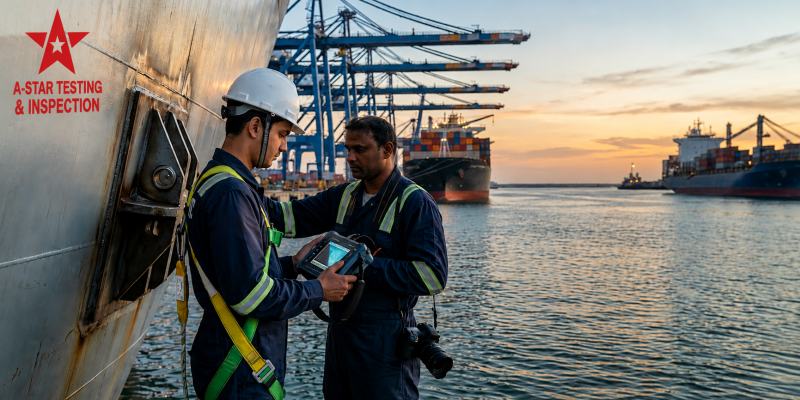
The marine and offshore industry is one of the toughest business environments in the world. Offshore drilling rigs, cargo vessels, pipelines that go under the ocean, or marine structures under the sea can be damaged by the elements, corrosion, mechanical stress and operational risks. It is for this reason that the Marine & Offshore Inspection is important for safety, compliance, and reliability for the Marine & Offshore operations.
As modern shipping firms, offshore operators, and marine infrastructure owners continue to seek solutions that help them avoid costly failures, environmental hazards, and downtime, advanced inspection solutions are becoming more crucial. The need for professional inspection services in India is growing at an increasing rate, with the expansion of offshore energy projects and the growth of maritime trade, and with the implementation of more stringent international safety regulations.
This guide covers the necessary background on the value of inspection services, important techniques in the industry, compliance requirements, and the benefits of preventive inspections in minimizing operational risks.
What is Marine & Offshore Inspection?
Marine and offshore inspection involves the assessment, testing, and monitoring of critical infrastructure, marine equipment, underwater structures, offshore rigs, and ships to ascertain structural integrity and safe operations.
These inspections are used to help identify:
- Rusting and decay of metal materials.
- Structural weaknesses
- Fatigue cracks
- Welding defects
- Thickness loss
- Equipment failures
- Safety compliance gaps
Marine & Offshore Inspection Company in India offers services to help the operators adhere to the industry standards and avoid the risks of accidents and unexpected shut downs.
Why Marine Inspections Are Essential
Seawater, pressure, humidity, and temperature changes are constant problems in marine environments, making them extremely aggressive. With no regular inspections, even minor defects can turn into major failures.
Key Benefits of Inspection Services
Improved Operational Safety
Regular inspections minimise the risks of structural damage, fire, equipment failure, and offshore accidents.
Regulatory Compliance
Marine operators must meet the standards set by classification societies, IMO, and IACS guidelines.
Reduced Downtime
It makes sure that defects are identified early, preventing sudden equipment breakdowns and expensive downtime.
Enhanced Asset Life
Offshore inspection and preventive maintenance enhance the life of marine vessels and assets.
Environmental Protection
The services provided by inspection services can help prevent oil spills, leakages, and structural failures that may affect marine ecosystems.
Types of Marine & Offshore Inspection Services
Contemporary inspection firms have a wide array of solutions that are tailored for the marine and offshore industries.
Rig Inspection Services
Periodic inspection of offshore rigs is necessary to ensure their safety and reliability in harsh conditions. A reputable Rig Inspection Company in India conducts thorough inspections of drilling rigs, lifting equipment, pipelines, and safety gear.
Common Rig Inspection Areas
- Inspection of derricks and masts.
- Crane and lifting equipment testing
- Structural integrity assessment
- Corrosion monitoring
- Safety system inspection
- Welding quality evaluation
Professional Rig inspection services in India assist the operators to ensure safety and reduce operational risks.
Underwater Inspection Services
Inspections are very specialized and difficult to carry out on underwater structures. Advanced technologies such as ROV (Remotely Operated Vehicle) and ultrasonic testing are commonly used.
Applications of Underwater Inspection
- Ship hull examination
- Offshore platform inspection
- Subsea pipeline assessment
- Assessment of jetty and port structures
- Marine foundation inspection
Many companies today use the most sophisticated underwater inspection services in India to uncover any hidden structural problems in advance before they turn into serious issues.
Leading underwater inspection services companies in India use divers, robotic systems, and non-destructive testing methods for accurate underwater analysis.
Importance of Ship Hull Thickness Measurement
One of the most important safety factors of a vessel is its integrity in Hull. The hulls also experience corrosion and constant exposure to seawater, which, over time, thins the hull, making it more susceptible to structural problems.
Why measuring thickness is important.
- Detects metal loss and corrosion
- Prevents hull failure
- Aids in the planning of dry docks.
- Ensures regulatory compliance
- Extends vessel lifespan
For vessel owners, precise Ship hull thickness measurement enables them to assess the condition of their ship’s structure and ensure its seaworthiness.
Ultrasonic Thickness Gauging for Marine Vessels
Ultrasonic testing is one of the most dependable techniques employed in contemporary marine surveys.
What is UTM?
Ultrasonic Thickness Guaging (UTM) for IACS Marine vessels is a non-destructive testing technique used to measure material thickness without damaging the structure.
The benefits of ultrasonic thickness testing include:The benefits of using ultrasonic thickness testing are:
- Highly accurate measurements
- Non-invasive inspection process
- Fast data collection
- Ideal for structures in water.
- Reliable corrosion assessment
The UTM inspections are commonly used on cargo ships, tankers, offshore platforms, and marine pipelines.
Asset Integrity Inspection in Offshore Industries
In the marine and offshore industry, Asset integrity management is a significant focus area. Operators of offshore assets need to make sure critical assets are safe, operational, and compliant throughout their life cycle.
What Is Included In Asset Integrity Inspection?
- Structural inspection
- Corrosion assessment
- Risk-based inspection planning
- Mechanical integrity evaluation
- Pipeline inspection
- Pressure vessel testing
A professional Asset integrity inspection service in India can be able to assist organizations to lower operational failures and enhance long-term reliability.
Technologies Used in Modern Marine Inspection
Inspection companies are now using cutting-edge technology to increase the accuracy, efficiency, and reporting of their inspections.
Popular Inspection Technologies
Non-Destructive Testing (NDT)
Does not require damage to structures or equipment to inspect.
Drone Inspection
Applies to structures off the coast and elevated surfaces that are difficult to access.
ROV Inspection
Best suited for use in underwater applications and subsea testing.
Ultrasonic Testing
Measures thickness and identifies flaws.
Magnetic Particle Testing
Detects cracks on the surface of metal parts.
Digital Inspection Reporting
Offers up-to-the-minute inspection data and compliance documents.
These technologies enhance safety and minimize human exposure to hazardous offshore environments.
Common Challenges in Offshore Inspection
Marine inspection operations come with a number of technical and environmental challenges.
Major Industry Challenges
- Extreme weather conditions
- Exposure to saltwater causes corrosion.
- Limited accessibility underwater
- High operational costs
- Adherence to international standards
- Aging offshore infrastructure
These are overcome efficiently by using professional inspection planning and advanced equipment.
How to Choose the Right Inspection Partner
It is essential to have an experienced inspection service provider to ensure safety standards on the offshore platforms.
Some important points to keep in mind:
- Industry certification and approvals
- Experienced inspection engineers
- Advanced NDT capabilities
- Following international norms
- Effective reporting and documentation systems.
- Offshore operational expertise
An expert inspection company can assist an organisation to boost its operational effectiveness whilst minimizing compliance dangers.
Frequently Asked Questions (FAQs)
Q1. Why do we inspect marine and offshore?
Ans: Marine inspections play a crucial role in maintaining the structural integrity, compliance with regulations, reliability of equipment, and efficiency of operations in marine and offshore environments.
Q2. What is the need for ultrasonic thickness testing in ships?
Ans: UTM testing helps to identify corrosion and metal loss to ensure that no vessel structural failure occurs and to ensure the safety of the vessel.
Q3. When do offshore rigs need to be inspected?
Ans: Periodic inspections are required for safety compliance, depending on regulatory requirements, operational conditions, and asset age.
Q4. What are underwater inspection services for?
Ans: Underwater inspections used for evaluating ship hulls, subsea pipelines, offshore platforms, marine foundations, and port infrastructure.
Q5. What does asset integrity management mean?
Ans: Asset integrity management is a method of ensuring safe and operational operation of offshore assets throughout their life cycle through inspection, maintenance, and risk assessment.
Conclusion
In the challenging world of marine work, it’s essential to have regular inspections to ensure safety, compliance, and efficiency. All inspection processes reduce risk, improve long-term asset performance, and/or asset integrity management, from underwater to rig assessment. Each inspection process offers the benefit of lowering risk and improving asset performance over the lifetime of the asset, whether it be underwater assessment, rig evaluation, ultrasonic thickness testing, or asset integrity management.
By investing in professional Marine & Offshore Inspection services, marine operators, offshore companies, and vessel owners can identify structural problems early on, avoid expensive failures, and meet international safety standards. With the industry moving forward, the use of cutting-edge inspection technologies and preventative maintenance practices will continue to play an important role in promoting safer, more reliable offshore work.